

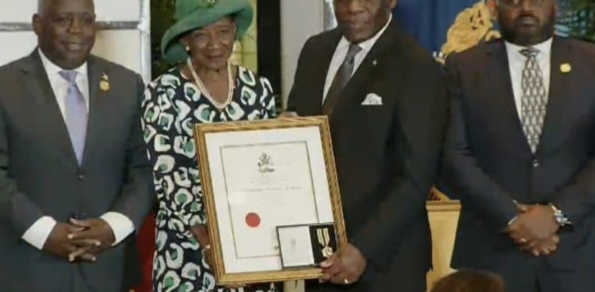
Israel Rolle recently received the British Empire Medal and has been nominated for a Cacique Award.
|

|
|
(Photo by Daphne McIntosh) |
| Israel “Bonefish Folley” Rolle |
He’s been bone fishing now for more than 60 years and has even had a song recorded in his honour.
But as Mr. Rolle sees it, he still has a whole lot of living to do.
People all over the world know him as "Bonefish Folley", the master bonefisher who has been one of this country’s most loved ambassadors.
Born on Andros, the largest island in the Bahamian archipelago, in the 1920s, the 85-year old spent a good part of his life in Bimini and has made West End, Grand Bahama his home over the past 25 years.
The father of seven says he never imagined his good fortune.
In an interview with The Bahama Journal, Bonefish Folley says he always appreciated the value of being kind to visitors to The Bahamas.
"I’ve always been kind to the tourists," he says. "You must treat them nice so that they want to come back again and again and again."
Mr. Rolle says it also helps to strive for excellence.
"You must know how to catch the fish that is hard to catch," he says. "You must know what to do to catch them. I’m good at what I do."
Mr. Rolle explains how it is that he knows the sport so well.
"First I used to deep-sea fish on a yacht many years ago on the ocean [off] Bimini. I was good at what I did [even then] and people who visited liked that and they would tell other people."
Bonefish Folley says he has taken thousands of people fishing from all over the world over the many years.
"I’ve fished with people from China and Japan, persons from all of the states within the USA, England, and from all over the world," he recalls.
Those persons include U.S. Ambassador to The Bahamas John Rood who befriended Bonefish Folley long before he was a diplomat.
But there were others like the late author Ernest Hemingway and the late civil rights activist Rev. Dr. Martin Luther King Jr.
They all got to know Bonefish Folley, who says he got the nickname decades ago.
"During the prohibition and rum running days in the 1920s, there used to be some folks who used to come to Bimini to sell booze to the folks who used to come over from the states. At that time, the U.S. didn’t allow the selling of liquor. So they used to come to Bimini and pick up liquor and take it over. It used to come from Nassau to Bimini and they’d pack it up and send it on a big ship," he recalls.
"The man who owned [the ship] his name was Folley. He had no kids. I used to be around him on the ship. He used to take me to school. When the folks came over they liked me. So they started calling me Folly, like an adopted son."
Mr. Rolle said the man’s name was Carl Folley.
"There are some people from Bimini who know me for a long time [and who still] call me Carl. I have a son named Carl after Carl Folley," he says.
Bonefish Folley’s memories of those days stretch back a long, long time, but it’s West End now that has become "sweet home" for him.
He in fact lives in a new house, built by the Rood family.
The gesture came after Bonefish Folley’s house was destroyed during Hurricane Frances in September 2004, and the veteran bonefisher says he will remain eternally grateful.
"Ambassador Rood and the prime minister came down here to see what happened. When [Mr. Rood] came I was sitting out by my boat. He told me then, don’t worry I’m going to build you a skyscraper."
Ambassador Rood kept his promise.
The home consisting of three bedrooms, and two baths was built on eight-feet high columns with the ability to withstand dangerous storm surges. It is considered to be a 'model home' for other residents of West End living on the waterfront.
For Bonefish Folly the waterfront is the ideal spot.
"I’m still fishing," he says. "The way I feel, I’ll probably go until I drop…I feel good. I had a complete checkup last week in Freeport, and [the doctor] told me that everything is kicking fine."